
UNBONDED POST-TENSIONING OF FACE LOADED URM CAVITY WALLS UNDER SEMI-CYCLIC AND DYNAMIC LOADING
NZSEE ANNUAL CONFERENCE (2020), PAPER 0122
Scope and methodology
Tested five full-scale, one-way vertically spanning URM cavity walls, 3000 mm high and 1150 mm wide. They were built from vintage 1930s clay bricks and a weak 1:2:9 cement:lime:sand mortar.
Two typologies were tested: 1+1 (two single leaves, 275mm thick) and 2+1 (a solid double leaf plus an external single leaf, 395 mm thick). Both had a 55 mm air cavity and notched wire ties to simulate corrosion.
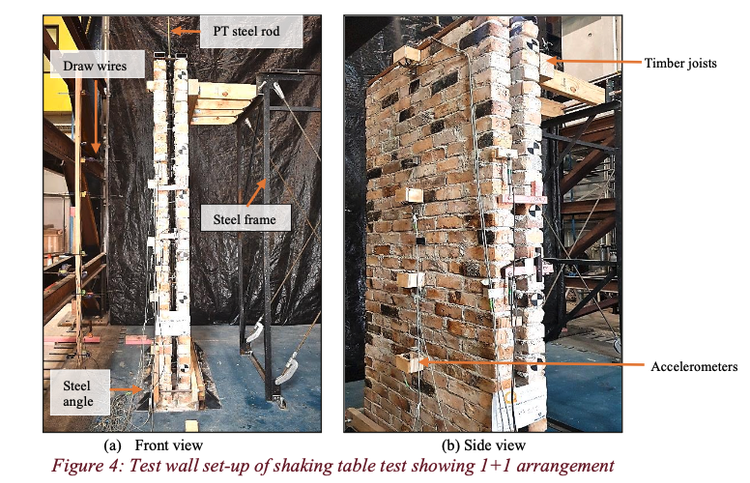
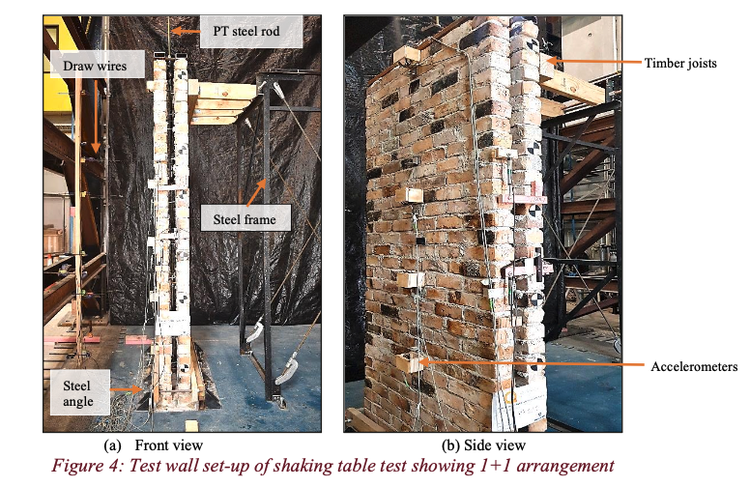
The retrofit was an unbonded 16 mm grade 8.8 threaded rod, post-tensioned to between 2.2 and 10–80 kN. It was anchored at the base with a steel plate, through-bolted short rods or a grout plug, and at the top with a 450 × 450 × 8 mm plate.
6 mm screw cavity ties, 240 mm long, connected the leaves at approx. 460 mm horizontal × 400 mm vertical centres to prevent buckling under PT load.
The top of each wall was restrained by a timber stringer fixed with three 8 mm × 240 mm PYTHON MT screws, representing a timber diaphragm connection.
Three walls were tested under semi-cyclic airbag loading and two on a shake table. The shake table used 2011 Christchurch earthquake records (LPCC and CBGS), scaled from 10% to 125%.
FINDINGS
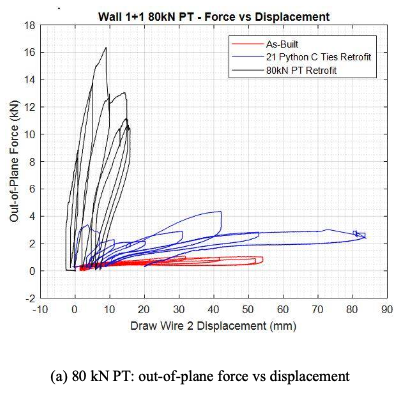
Post-tensioning increased out-of-plane capacity by about 4× compared with as-built walls of the same configuration.
The 1+1 wall reached 16.4 kN, about 1.2g, against a 1.1 kN as-built capacity. The 2+1 wall peaked at 39.1 kN, about 2.0g, at 110 mm displacement.
Wall arching raised the rod tension during loading. The force rose 130% from a 10 kN initial load, and from 18 to about 80 to 110 kN. Low initial PT forces still engaged the system.
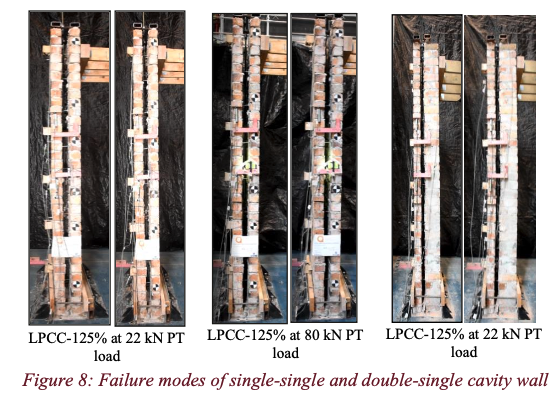
On the shake table, the 1+1 wall at 80 kN PT showed no noticeable damage after seven records up to LPCC-125% (PGA 1.03g). At 22 kN, only minor cracking occurred at PGA 1.21g (1+1) and 1.1g (2+1), with no sign of wall instability.
Mid-height drift at 22 kN PT was 1.75% (1+1) and 1.07% (2+1). Raising PT to 80 kN cut the 1+1 wall displacement by about 38%.
At ultimate load, the walls cracked and slid just below the rod anchorage. This reflected the test setup. In a building, the rod would extend below the floor diaphragm and prevent this mode.
Unbonded post-tensioning was found to be a cost-effective and constructible way to significantly improve the seismic performance of URM cavity walls.